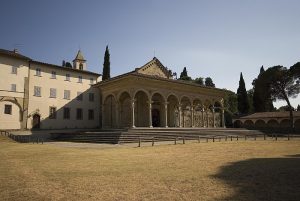



The Basilica of St. Francis: one of Arezzo’s artistic symbols
The Basilica of St. Francis of Arezzo (Basilica di San Francesco) one of the most significant landmarks from a historical, artistic and cultural perspective in the city. Located in the heart of the Old Town, in the square that shares its name, the Basilica is an essential point of reference for anyone wishing to understand the city’s deep-rooted identity, where Franciscan spirituality and great Renaissance art meet in a truly unique way.
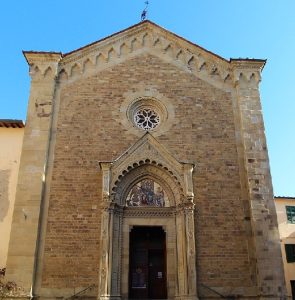
From an architectural point of view, the church features a sober and austere style typical of the Franciscan tradition, emphasised by its famous unfinished façade, which has remained without the cladding planned as early as the 14th century. This essential aesthetic, far from being a limitation, introduces visitors to a treasure chest of extraordinary artistic richness preserved inside.
The Basilica’s location is also particularly convenient for those staying in the historic centre: the B&B Antiche Mura is located just a few steps from the church, directly overlooking Piazza San Francesco. This proximity allows guests to reach the Basilica easily on foot, perhaps in the early morning or late afternoon, enjoying the visit at a relaxed pace and without logistical constraints.
What to see inside the Basilica of St. Francis
A visit to the Basilica of St. Francis offers the opportunity to discover an artistic heritage of exceptional value, layered over several centuries. The church’s spacious and bright interior houses works that recount the evolution of art in Arezzo from the Middle Ages to the height of the Renaissance, making the Basilica not only a place of worship but also a true museum.
Among the main works and spaces to admire during the visit are:
- The Bacci Chapel, the artistic heart of the Basilica and the most famous space in the entire complex
- The fresco cycle of the Stories of the True Cross, an absolute masterpiece by Piero della Francesca
- The 14th- and 15th-century frescoes in the side chapels, attributed to masters such as Spinello Aretino and painters of the Arezzo school
- The large medieval Crucifix located near the main chapel
- The stained-glass windows, including the 16th-century one by Guillaume de Marcillat
- The noble chapels, decorated with frescoes and valuable Renaissance artworks
- The lower church, now used as an exhibition space
The history of the Basilica of St. Francis: from medieval origins to the present day
The history of the Basilica of St. Francis is closely linked to the presence of the Franciscan Order in Arezzo, documented as early as the beginning of the 13th century. After an initial settlement outside the city walls, in 1290 the friars received an official invitation from the municipality to move within the city, initiating the project for a new and larger church. The building was conceived according to the principles of Franciscan architecture, with a single nave and a sober style, and is attributed to the architect Fra Giovanni da Pistoia.
Construction began in the 14th century and continued for several decades, culminating in the completion of the main chapel in 1374. Over the centuries, the Basilica went through phases of transformation, abandonment and restoration, culminating in the 19th- and 20th-century interventions that restored its original appearance. In 1955, the church was officially elevated to the rank of minor basilica.
Antiche Mura: the ideal starting point for visiting the Basilica of St. Francis
Staying in Arezzo’s historic centre allows visitors to experience the city at a slower and more authentic pace, and the B&B Antiche Mura is a particularly strategic choice for those wishing to visit the Basilica of St. Francis and the city’s main attractions. The property directly overlooks Piazza San Francesco, just a few metres from the Basilica’s entrance, making it easy to reach on foot in moments.
This privileged location offers a concrete advantage especially for visiting the Bacci Chapel, where access is limited and requires advance booking with specific time slots. Staying so close allows guests to organise their visit without travelling, avoiding the use of a car and fully enjoying the historic centre. Antiche Mura is also an excellent starting point for exploring other highlights of Arezzo on foot, such as Corso Italia, Piazza Grande and the Cathedral, turning the stay into a complete cultural experience immersed in the city’s history and art.
The artistic masterpieces housed in the Basilica of St. Francis

The Basilica of San Francesco preserves one of the most important artistic heritages in all of Tuscany, the result of centuries of patronage, decorative interventions and stylistic layering. In addition to being a place of worship, the Basilica now also serves a museum function and is part of the national museum circuit, bearing witness to the historical and cultural value of the works preserved inside.
The apparent architectural simplicity of the church contrasts with the richness of the pictorial decorations that unfold along the nave and in the side chapels. Here, significant examples of medieval, late Gothic and Renaissance art coexist, offering visitors a chronological journey spanning more than two centuries of art history. Monumental frescoes, narrative pictorial cycles, stained-glass windows and sculptural works interact harmoniously within the space, making the visit an experience of great visual and cultural intensity.
Among all these treasures stand universally renowned masterpieces, alongside lesser-known yet extraordinarily interesting works, which together make the Basilica of St. Francis an unmissable stop for anyone visiting Arezzo.
The Stories of the True Cross by Piero della Francesca
The most famous masterpiece housed in the Basilica of St. Francis is undoubtedly the fresco cycle of the Stories of the True Cross, painted by Piero della Francesca inside the Bacci Chapel. Commissioned by the homonymous family of Arezzo merchants, the cycle was executed between 1453 and 1466 and represents one of the absolute peaks of Italian Renaissance painting.
The fifteen scenes recount the legend of the True Cross through a rigorous composition characterised by a masterful use of perspective, light and geometric balance. Piero della Francesca succeeds in blending sacred narrative and mathematical research, offering images of extraordinary clarity and monumentality. The Bacci Chapel is now a museum space, with access regulated by limited-entry time slots to protect the frescoes. This makes the visit an intimate and highly immersive experience, fully conveying the expressive power of one of the most important pictorial cycles in the history of Western art.
The 14th- and 15th-century frescoes: Spinello Aretino and the local school
Alongside the celebrated cycle by Piero della Francesca, the Basilica of St. Francis preserves an important nucleus of 14th- and 15th-century frescoes that testify to the artistic vitality of Arezzo in the late Middle Ages. Among the leading figures is Spinello Aretino, one of the foremost interpreters of Tuscan painting between the 14th and 15th centuries.
His works, visible in some of the side chapels, are distinguished by the strong dynamism of the scenes, the expressive intensity of the figures and the decisive use of colour. Alongside Spinello worked other masters of the Arezzo school, such as Parri Spinelli, Andrea di Nerio and Giovanni d’Agnolo di Balduccio, authors of pictorial cycles that are today partially fragmentary yet still legible. These frescoes enrich the visitor’s itinerary, offering a valuable insight into the evolution of local painting prior to the emergence of mature Renaissance language.
Chapels, stained glass and lesser-known Renaissance works
In addition to its most famous masterpieces, the Basilica of St. Francis houses numerous lesser-known yet highly valuable artistic treasures, distributed along the nave and in the side chapels. Among these stand out the stained-glass windows, such as the one created in 1524 by Guillaume de Marcillat, which enriches the counter-façade with a refined use of colour and light.
Of particular interest are also the noble chapels, including the Guasconi Chapel and the Tarlati Chapel, decorated with frescoes attributed to masters active between the 15th century and the early Renaissance. Here, visitors can admire works linked to the Tuscan pictorial tradition, with influences anticipating the mature Renaissance language. Equally significant is the large medieval Crucifix located near the main chapel, a testament to profound Franciscan spirituality. These elements, often observed with less attention, complete the visitor’s journey and contribute to making the Basilica a place of extraordinary artistic and historical richness.
Staying in Arezzo to discover the Basilica of St. Francis
Visiting the Basilica of San Francesco deserves time and attention, which is why choosing to stay in the historic centre represents added value for those wishing to experience Arezzo authentically. Staying at the B&B Antiche Mura allows guests to organise their visit to the Basilica with maximum freedom, without travel constraints and with the possibility of returning to the square several times throughout the day.
The proximity to the Bacci Chapel is particularly advantageous also in relation to limited access, which requires precise time slots and advance booking. After the visit, the historic centre opens up into a route rich in museums, churches, artisan shops and charming views, all reachable on foot. Staying at Antiche Mura, a B&B in the centre of Arezzo, means immersing yourself in the city’s history and art, experiencing it calmly and continuously, and transforming a visit to the Basilica of St. Francis into a complete and rewarding cultural experience.
Piazza San Francesco: culture, cafés and city life
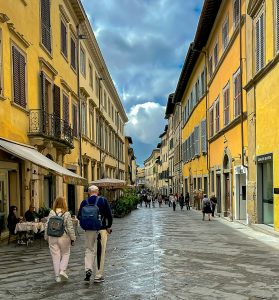
Piazza San Francesco is one of the most lively and authentic spaces in Arezzo’s historic centre, a place where cultural heritage naturally intertwines with everyday life. After visiting the Basilica of St. Francis, the square invites visitors to linger and enjoy its relaxed atmosphere, thanks to the presence of numerous cafés, wine bars and restaurants overlooking the square.
Here it is possible to enjoy an aperitivo or a gastronomic break, tasting typical Tuscan products and local wines while observing the slow rhythm of city life. The square is frequented by both visitors and locals, making it an authentic meeting place rather than an exclusively tourist area. Especially in the evening hours, Piazza San Francesco becomes the ideal place to end a day dedicated to art, extending the cultural experience in a convivial and pleasant setting, just a few steps from the B&B Antiche Mura.
What to see near the Basilica of St. Francis
Thanks to the central location of the Basilica of St. Francis, it is possible to explore a wide range of historical and cultural attractions in the centre of Arezzo on foot. In the immediate surroundings of the square, a rich and varied itinerary unfolds, ideal for a full day of sightseeing:
- Teatro Petrarca – A historic 19th-century theatre and a key reference point for the city’s cultural life.
- Corso Italia – The main commercial and monumental axis running through the historic centre.
- Piazza Grande – A charming medieval square, famous for the Giostra del Saracino.
- Arezzo Cathedral – The Cathedral of Saints Peter and Donatus, with stained glass windows and Renaissance artworks.
- National Archaeological Museum Gaio Cilnio Mecenate – An important collection of Etruscan and Roman artefacts.
- Roman Amphitheatre – An archaeological area bearing witness to Roman Arezzo.
- Basilica of San Domenico – Famous for the Crucifix by Cimabue.
- Casa Vasari – The frescoed home of Giorgio Vasari, now a state museum.
- Medici Fortress – A panoramic viewpoint overlooking the city and surrounding valley.
- Pieve of Santa Maria – A masterpiece of Arezzo Romanesque architecture overlooking Corso Italia.