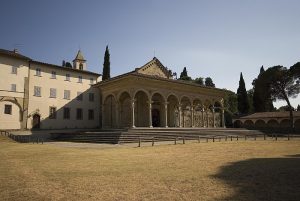



History and Foundation of the Fraternita dei Laici
The Fraternita dei Laici of Arezzo, one of the oldest and most prestigious lay institutions in Italy, was founded in the second half of the 13th century. Established as the Pious Confraternity of Mercy in 1262 by decree of Bishop Guglielmino degli Ubertini, it aimed to help the poor and the sick, configuring itself as a congregation of lay people with religious inspiration and Marian devotion.
Over the centuries, the Fraternity accumulated wealth and influence through numerous bequests and donations, which enabled it to carry out numerous welfare tasks and obtain the governance of hospitals and shelters. During the Lorraine period, it became Arezzo’s main cultural and political reference point. Today, the Fraternita dei Laici continues to maintain its social, cultural and welfare function, representing a pillar of the Arezzo community and a guardian of local history and traditions.
Architecture and Construction of the Palace
The Palace of the Fraternita dei Laici is an architectural masterpiece reflecting centuries of history and art. Construction began in 1375 on a design by Florentine masters Baldino di Cino and Niccolò di Francesco. The Gothic facade was enriched in 1395-1396 with Spinello Aretino’s fresco of “Christ in Pity.” In 1433, the construction of the second floor was entrusted to Bernardo Rossellino, who added the sculptural group of the “Madonna of Mercy with Saints Lorentino and Pergentino” and the statues of “Saint Donato” and “Blessed Gregory.”
Gothic architecture blended harmoniously with Renaissance elements, culminating in Giuliano da Settignano’s gallery in 1461. Between 1549 and 1550, Giorgio Vasari designed the bell gable, which houses Felice Salvatore da Fossato’s astronomical clock. The extension of the left facade was carried out in the 17th century, following a Vasari design, thus consolidating the eclectic beauty of the Palace.
Facade of the Palace
The facade of the Palazzo della Fraternita dei Laici is an elegant combination of Gothic and Renaissance styles that tells the rich artistic history of Arezzo. In the center of the facade is a portal with strong splaying, adorned with a lunette that originally contained Spinello Aretino’s fresco “Christ in Pieta,” now displayed inside the museum.
Above the lunette, the sculptural group of the “Madonna of Mercy” with Saints Lorentino and Pergentino, by Bernardo Rossellino, dominates the scene. Statues of “Saint Donato” and “Blessed Gregory,” also by Rossellino, flank the central group, adding a solemn dimension to the facade. In 1460, Giuliano and Algozzo da Settignano added a loggia with a balustrade with an amphora motif. Finally, the crowning of the facade, designed by Giorgio Vasari in 1552, includes a bell sail that houses the astronomical clock, giving a final touch of majesty to the entire building.
Bell Tower and Astronomical Clock
The bell gable of the Palazzo della Fraternita dei Laici is one of the most distinctive elements of the building, designed by Giorgio Vasari between 1549 and 1550. The bell tower houses a unique astronomical clock, made in 1552 by master clockmaker Felice di Salvatore da Fossato. This clock, rare in Europe and unique in Italy for its size and functionality, not only marks the hours but also provides astronomical information such as the position of the Sun and Moon, following the 16th-century Ptolemaic conception of the universe.
The clock is connected to three bells, each ringing at different times of the day, with the central bell marking the hours. After several restorations, the most significant in 1998 and 2002, the clock has recovered all of its original functionality. Indeed, the bell tower and astronomical clock represent an extraordinary testimony to the technical and artistic ingenuity of the Arezzo Renaissance.
The Audience Hall of the Fraternita dei Laici and the Works of Parri di Spinello
The Audience Hall of the Palace of the Fraternita dei Laici is one of the most striking and historically rich rooms in the building. Here is one of the most significant works by Parri di Spinello, son of the famous painter Spinello Aretino: the “Majesty or Madonna of Mercy with Saints Donato and Gregory” from 1448. This altarpiece, commissioned by the Fraternity, depicts the Madonna and Child under her protective mantle, a recurring theme in works commissioned by the institution.
This room also houses other valuable frescoes, including Spinello Aretino’s “Christ in Pietà,” moved here to preserve it. The works by Parri di Spinello and his father Spinello bear witness to the Fraternita’s Marian devotion and their connection with the leading artists of the period. Audience Hall, with its masterpieces, represents a place of great cultural and spiritual importance for the city of Arezzo.
The Collections of the Museum of the Fraternita dei Laici
The Museum of the Fraternita dei Laici houses a vast and valuable collection of works of art reflecting centuries of history and culture. These collections are derived from donations, testamentary bequests and public commissions accumulated from the 14th to the 19th century. Among the treasures preserved are paintings, sculptures, drawings, prints, and antique furniture. These masterpieces represent an important testimony to the rich artistic tradition of Arezzo and Tuscany.
The collection includes works by such prominent artists as Spinello Aretino, Parri di Spinello, and Bernardo Rossellino. In particular, the museum holds about 6,000 works from the Bartolini Collection, donated to the Fraternita by Arezzo sculptor Ranieri Bartolini in the 19th century. These works are displayed in rotation, offering visitors a continuous rediscovery of the artistic heritage.
Treasures of Arezzo and Temporary Exhibitions
The Museum of the Fraternita dei Laici in Arezzo hosts a permanent exhibition called “Treasures of Arezzo,” which opened in 2017 and highlights the city’s artistic and craftsmanship excellence. The exhibition includes an extraordinary collection of jewelry and unique pieces created by renowned Italian design masters such as Ettore Sottsass, Giò Pomodoro, Dolce and Gabbana, and Salvatore Fiume.
In addition to the permanent exhibition, the museum holds regular temporary exhibitions that explore various aspects of Arezzo’s art, history, and culture. These temporary exhibitions offer visitors the opportunity to view works of great historical and artistic value that would otherwise not be accessible to the public. Among the most celebrated exhibitions was the display of the bronze statue of Minerva of Arezzo, found in 1541 and usually kept at the National Archaeological Museum in Florence.
The Historical Archives of the Fraternita dei Laici
The Historical Archives of the Fraternita dei Laici is one of the most important documentary resources for the history of the city of Arezzo. It preserves documents ranging from the 14th to the 19th century, offering valuable evidence of the Fraternity’s activities and city life over the centuries. The archive contains manuscripts, notarial acts, registers, letters and other documents that illustrate the Fraternity’s rich institutional and welfare history.
This documentary treasure is an irreplaceable source for scholars, researchers and local history enthusiasts. The Fraternity provides a study room open to the public where these documents can be consulted. The archives not only document the evolution of the Fraternity, but also reflect the social, economic and political changes in Arezzo and Tuscany. Thanks to careful cataloging and preservation, the Historical Archives continues to be a vital resource for understanding the past and enhancing the city’s cultural heritage.
The Palace of the Fraternita dei Laici today
Today, the Palace of the Fraternita dei Laici continues to be an important cultural and social center in the heart of Arezzo. After restoration and reopening in 2010, the Palazzo not only houses the Fraternita Museum, but also various cultural institutions such as the Casa della Musica di Arezzo (CAMU), a center dedicated to musical training and research that organizes concert activities. The halls of the Palace host temporary exhibitions, cultural events and conferences, making this historic building a vibrant landmark for the community.
A marvelous panoramic terrace, accessible to visitors, offers breathtaking views of Arezzo’s historic center and surrounding hills. The Fraternity’s commitment to preserving and enhancing the historical and artistic heritage is reflected in the many cultural initiatives that enrich the life of the city. The Palace of the Fraternita dei Laici thus remains an enduring symbol of Arezzo’s tradition, culture and innovation.