


The Basilica of San Domenico: one of the most important landmarks in Arezzo’s historic centre
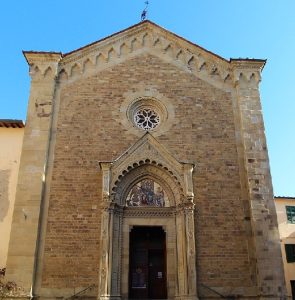
The Basilica of San Domenico is one of the most significant religious and artistic buildings in Arezzo and an essential stop for anyone who wishes to truly discover the city’s historic centre. Located in the square of the same name, just a few minutes from the Cathedral and in one of the most fascinating areas of upper Arezzo, the basilica immediately stands out for its austere and solemn appearance. Its distinctive, asymmetrical Gothic façade, built from pietra forte stone, introduces visitors to a fascinating interior featuring a single nave, a timber-trussed roof and an artistic heritage spanning centuries of history.
San Domenico is not only a church of great architectural value, but also one of the places that best illustrates the connection between Arezzo, Dominican spirituality and medieval and Renaissance painting. Here, art and faith are closely intertwined through works that make the basilica one of the city’s most precious cultural treasures.
For guests staying at the B&B Antiche Mura, visiting the Basilica of San Domenico is particularly easy. The property is conveniently located near the square, allowing guests to reach the church within a few minutes on foot and easily include it in an itinerary exploring the great attractions of Arezzo’s historic centre.
What to see inside the Basilica of San Domenico
Visiting the Basilica of San Domenico means entering one of the richest places in Arezzo in terms of art and history. Despite its understated exterior, the interior of the church contains an artistic heritage of immense value, spanning several centuries and documenting the evolution of painting and sculpture in the Arezzo area.
The main artworks and features to observe during your visit include:
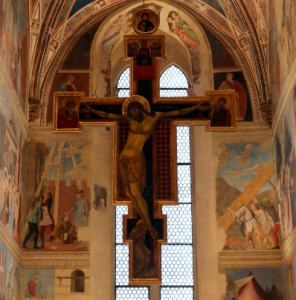
- The Crucifix by Cimabue, one of the most important masterpieces of thirteenth-century Italian painting
- The frescoes by Spinello Aretino and Parri di Spinello, among the finest examples of the local school of painting
- The Dragomanni Chapel, with its Gothic structure and painted decorations
- The glazed terracotta sculpture of Saint Peter Martyr by the Della Robbia family
- The funerary monument of Ranieri degli Ubertini, one of the oldest examples of a wall-mounted tomb in Arezzo
- The architectural structure of the church, with its single nave and timber-trussed roof, typical of the Gothic style
- The collection of fourteenth- and fifteenth-century frescoes decorating the interior walls
These features represent only part of the artworks preserved inside the basilica, but they already provide a clear idea of the extraordinary artistic wealth visitors can admire. In the following sections, we will explore the main masterpieces and their historical and cultural significance.
When the Basilica of San Domenico was built and why it is so important
The origins of the Basilica of San Domenico date back to the height of the thirteenth century, a period of major religious and cultural development for the city of Arezzo. The Dominican friars, who arrived in the city around the 1230s, gradually consolidated their presence until they decided to build their own church and convent. Construction of the basilica began in 1275 and continued until the early fourteenth century, supported financially by prominent Arezzo families such as the Ubertini and the Tarlati.
From the earliest stages of its construction, the church played a central role in the city’s religious life. One particularly significant event took place in January 1276, when the still-unfinished basilica hosted what is considered the first conclave in the history of the Church of Rome, underlining its importance even during the medieval period.
Over the centuries, the basilica underwent several transformations. During the sixteenth century, new altars were added and many of the frescoed walls were whitewashed, altering the original appearance of the interior. Later, in 1782, following the religious reforms of the Grand Duchy of Tuscany, the church was abandoned and remained in a state of neglect until the beginning of the twentieth century.
It was during the twentieth century that major restoration work began. Completed in 1924, these interventions made it possible to recover the medieval frescoes and restore the basilica to a condition closer to its original appearance. Finally, in 1960, Pope John XXIII officially granted the church the status of minor basilica, definitively confirming its historical, artistic and religious importance.
Antiche Mura: accommodation in the heart of Arezzo, just a few steps from San Domenico
Staying in Arezzo’s historic centre allows visitors to experience the city in a more authentic way, walking between its main places of interest. In this context, Antiche Mura is a particularly strategic accommodation option for anyone wishing to visit the Basilica of San Domenico and, more generally, the attractions of the upper part of the city.
The property is conveniently located near Piazza San Domenico: the basilica can be reached within a few minutes on foot, without needing to use a car or follow complicated routes. This makes the visit simple and immediate, whether you are planning a brief stop during the day or a more extensive itinerary through the historic centre.
In addition to its proximity to the basilica, Antiche Mura also provides easy access to other places of interest, including the Cathedral, the medieval walls and the city’s main squares. Its central location therefore makes it possible to organise your visit smoothly, alternating art, history and relaxing moments without long journeys.
For visitors who wish to discover Arezzo at a relaxed pace from a well-positioned base, Antiche Mura is an ideal starting point for exploring the city’s treasures, beginning with the Basilica of San Domenico.
The artworks inside the Basilica of San Domenico
The Basilica of San Domenico is one of Arezzo’s main repositories of sacred art and an essential landmark for understanding the development of painting between the thirteenth and fifteenth centuries. For centuries, its walls provided a space for experimentation by local artists and others, turning the church into a genuine training ground for the Arezzo school of painting.
Inside the church are works created by some of the leading figures of the medieval and Renaissance artistic scene. These artists were influenced by both the Sienese and Florentine traditions, while also developing an independent and recognisable style. The frescoes, sculptures and decorations tell a story spanning several centuries, illustrating the evolution of artistic style and sensitivity over time.
The richness of the basilica’s artistic heritage lies not only in the number of works it contains, but also in their quality and historical significance. Every feature, from the large painted compositions to the architectural details, contributes to creating a coherent whole in which art and spirituality blend harmoniously.
The following sections explore some of the most important masterpieces preserved inside the Basilica of San Domenico, providing a deeper understanding of their significance and the role they have played in the history of Italian art.
The Crucifix by Cimabue: the basilica’s most celebrated masterpiece
Among the works preserved inside the Basilica of San Domenico, the Crucifix by Cimabue is undoubtedly the most famous masterpiece and one of the main reasons why the church is an essential destination for art enthusiasts. Created between approximately 1265 and 1268, it is an early work by Cenni di Pepo, known as Cimabue, who is considered one of the great innovators of Western painting.
The Crucifix occupies a commanding position, suspended above the high altar, and immediately impresses visitors with the expressive power of the figure of Christ. Unlike the more rigid and symbolic representations of the Byzantine tradition, Cimabue introduces greater attention to the human dimension: the body appears more natural, the suffering is depicted more clearly and the face conveys a new emotional intensity.
This work marks a fundamental step towards Renaissance painting, anticipating the pursuit of realism and depth that would later be developed by artists such as Giotto. It is therefore not merely a decorative feature, but a turning point in the history of art, making the Basilica of San Domenico a place of great international importance.
Seeing Cimabue’s Crucifix in person allows visitors to fully understand the scope of this innovation, within an architectural setting that enhances both its presence and its symbolic value.
The frescoes by Spinello Aretino and Parri di Spinello
Among the most distinctive features of the interior of the Basilica of San Domenico are the frescoes created by Spinello Aretino and his son Parri di Spinello, leading figures in Arezzo painting between the late fourteenth and early fifteenth centuries. Their works document a period of great artistic vitality for the city, during which Sienese and Florentine influences blended with a recognisable local style.
Some of the most significant compositions can be found on the inner façade of the basilica. On the left-hand wall, Spinello Aretino painted the Stories of Saints Philip and James the Less, accompanied by scenes from the life of Saint Catherine. These works, dating from approximately 1395 to 1400, belong to the artist’s mature period and display complex storytelling and remarkable attention to detail.
On the right-hand wall is the Crucifixion with the Virgin Mary, Saint Nicholas, Saint John and Saint Dominic, painted by his son Parri di Spinello during the early fifteenth century. Here too, the scene is enriched with narrative elements that reveal the stylistic continuity between father and son, as well as a gradual evolution in their pictorial language.
In addition to these major works, other frescoes are preserved along the walls of the nave. Some remain in good condition, while others survive only in fragments. Together, they help convey the basilica’s importance as a centre of artistic production during the medieval period. Collectively, these paintings make a visit to San Domenico an essential experience for understanding the development of painting in Arezzo.
Chapels, funerary monuments and sculptures: the other treasures of San Domenico
In addition to its major fresco cycles, the Basilica of San Domenico contains a series of lesser-known works of great historical and artistic value, making the visit even more rewarding. These include chapels, funerary monuments and sculptures that illustrate different periods in the history of the city and its artistic tradition.
One of the most interesting features is the Dragomanni Chapel, characterised by a Gothic structure with a double pointed arch and a carved stone altar dating from the fourteenth century. Inside is the fresco depicting the Dispute between Jesus and the Doctors in the Temple, attributed to Donato and Gregorio d’Arezzo, which testifies to the vitality of local artistic production during the fourteenth century.
The funerary monument of Ranieri degli Ubertini is also particularly significant. It is one of the oldest surviving examples of a wall-mounted tomb in Arezzo. Attributed to Gano di Fazio, the work features a Gothic canopy and a sculptural composition of great expressive power, reflecting the importance of the Ubertini family in the city’s history.
Among the sculptures, another notable work is the glazed terracotta depicting Saint Peter Martyr, created between 1515 and 1520 by Giovanni and Girolamo della Robbia and representing the Tuscan artistic tradition associated with this celebrated family. Other sculptures and decorations include the stone Madonna and Child, originally from the city’s ancient walls and now preserved inside the church.
Together, these works complete the basilica’s artistic heritage, offering a broader perspective on the variety of languages and techniques that characterised artistic production in Arezzo over the centuries.
Book your stay at Antiche Mura to visit the Basilica of San Domenico and Arezzo’s historic centre
Visiting the Basilica of San Domenico means entering one of the most representative places in Arezzo’s artistic and religious history. To fully enjoy this experience, choosing accommodation in the historic centre makes it easier to move around and organise your visit without complicated journeys.
By staying at Antiche Mura, visitors can reach the basilica within a few minutes on foot and easily include it in a wider itinerary that also takes in the Cathedral, the medieval walls and the city’s main squares. This proximity makes it possible to explore these places at a relaxed pace and even return to them several times to appreciate their details.
Booking accommodation in the historic centre also means experiencing Arezzo in a more authentic way, alternating sightseeing with relaxing breaks among the city’s streets. When planning a trip to Arezzo, Antiche Mura provides an ideal base for discovering the Basilica of San Domenico and all the other wonders of the historic centre, with the convenience of having everything within walking distance.
Piazza San Domenico: a central location near the Cathedral and other iconic landmarks in Arezzo
Piazza San Domenico is one of the most interesting urban spaces in Arezzo’s historic centre, not only because of the basilica, but also because of its strategic position in relation to the city’s other major landmarks. Located in the upper part of the centre, the square is a natural stopping point for visitors who wish to explore Arezzo along a logical route that can easily be followed on foot.
Just a few minutes from the basilica stands the Cathedral of Saints Peter and Donatus, one of the city’s most important religious buildings, together with the Colle del Pionta, an area of major historical interest connected to the Christian origins of Arezzo. The proximity of these places makes it possible to create a rich cultural itinerary without having to travel long distances.
With its open spaces and harmonious architectural surroundings, the square is also an ideal place to pause during your visit. From here, visitors can continue towards other parts of the historic centre, including Piazza Grande and the city’s most characteristic streets, while maintaining a natural continuity throughout the itinerary.
This central location makes the Basilica of San Domenico not only a destination of immense artistic value, but also an excellent reference point for exploring the entire historic centre of Arezzo.
What to see near the Basilica of San Domenico
A visit to the Basilica of San Domenico can easily be incorporated into a broader itinerary exploring Arezzo’s historic centre, one of the richest and most fascinating in Tuscany. Several of the city’s most important landmarks are concentrated around the square and can be reached within a few minutes on foot.
The main attractions include the Cathedral of Saints Peter and Donatus, with its stained-glass windows, and Piazza Grande, the historic heart of the city. Also nearby are the Ivan Bruschi House Museum, the birthplace of Francesco Petrarch and the evocative medieval walls, allowing visitors to create a complete itinerary encompassing art, history and culture.
Staying in the historic centre makes it possible to visit all these attractions with ease, without complicated journeys, while experiencing Arezzo in a more authentic way.
Book your stay at the B&B Antiche Mura now and discover the convenience of having the Basilica of San Domenico and the city’s main attractions just a few minutes away on foot. Experiencing Arezzo from the historic centre means making the most of your time and truly enjoying every corner of the city, without taking precious moments away from your holiday.